About thyroid eye disease

Thyroid eye disease (TED): a progressive autoimmune disease1

TED is characterized by inflammation of, growth of, and damage to tissues around and behind the eyes.1-3

Most often, TED occurs when the thyroid gland is overactive. Less frequently, TED can occur in people who have normal or underactive thyroids.4 An estimated 85% of people with TED also have Graves’ disease.1 Given the close association between these 2 autoimmune conditions, TED is sometimes referred to as Graves’ orbitopathy.5

TED has an active inflammatory phase that is followed by a chronic fibrotic phase. Even after initial treatment and improvement, symptoms may persist or flare over time.3
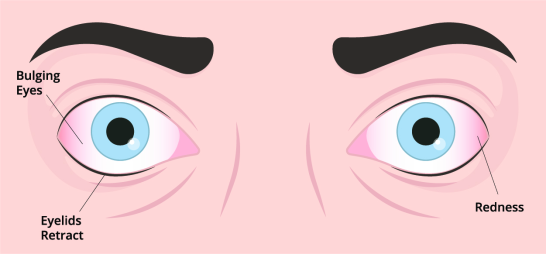

Thyroid eye disease (TED)

What is the pathology of TED?

The autoimmune, inflammatory, and fibrotic processes are primarily caused by the TSH receptor (TSHR) and the IGF-1 receptor (IGF-1R) autoantibody-mediated activation of orbital fibroblasts. This leads to cytokine release, hyaluronan production, and adipose tissue expansion, resulting in muscle swelling and fat enlargement in the eye.1-3,6

What are the symptoms of TED?

Common symptoms include5:

  • Bulging eyes (proptosis)

  • Double vision (diplopia)

  • Dry eyes

  • Redness of the eyes

  • Pain in and around the eyes

  • Eyelid retraction

  • Swelling of the eyes and surrounding area

In severe cases, TED can lead to damage to the eyes and even loss of sight.7

IGF-1R=insulin-like growth factor-1 receptor; TSH=thyroid stimulating hormone.

Lumvoa has been studied in both active and chronic TED8

  1. Tamhankar MA, Raza S, Brutsaert E, et al. The burden of illness in thyroid eye disease: current state of the evidence. Front Ophthalmol (Lausanne). 2025;5:1565762. doi:10.3389/fopht.2025.1565762
  2. Aoun T, Danielova Gueorguieva D, Wu KY. Orbital inflammation in thyroid eye disease: stress responses and their implications. Stresses. 2024;4(1):54-78. doi:10.3390/stresses4010004
  3. Vincent AB, Engelmann AR, Hwang CJ, Nasr C. Thyroid eye disease: what's the latest? Cleve Clin J Med. 2025;92(11):693-701. doi:10.3949/ccjm.92a.25043
  4. Muñoz-Ortiz J, Sierra-Cote MC, Zapata-Bravo E, et al. Prevalence of hyperthyroidism, hypothyroidism, and euthyroidism in thyroid eye disease: a systematic review of the literature. Syst Rev. 2020;9(1):201. doi:10.1186/s13643-020-01459-7
  5. Cleveland Clinic. Thyroid eye disease. (Graves’ eye disease). March 2, 2025. Accessed February 17, 2026. https://my.clevelandclinic.org/health/diseases/17558-thyroid-eye-disease
  6. Yuan X, Li H, Wang F. The therapeutic revolution in thyroid eye disease: from orbital radiotherapy to teprotumumab and AI. Front Med (Lausanne). 2026;13:1758015. doi:10.3389/fmed.2026.1758015
  7. Scarabosio A, Surico PL, Singh RB, et al. Thyroid eye disease: advancements in orbital and ocular pathology management. J Pers Med. 2024;14(7):776. doi:10.3390/jpm14070776
  8. Lumvoa™ (veligrotug-vvze). Prescribing Information. Viridian Therapeutics, Inc; 2026.